
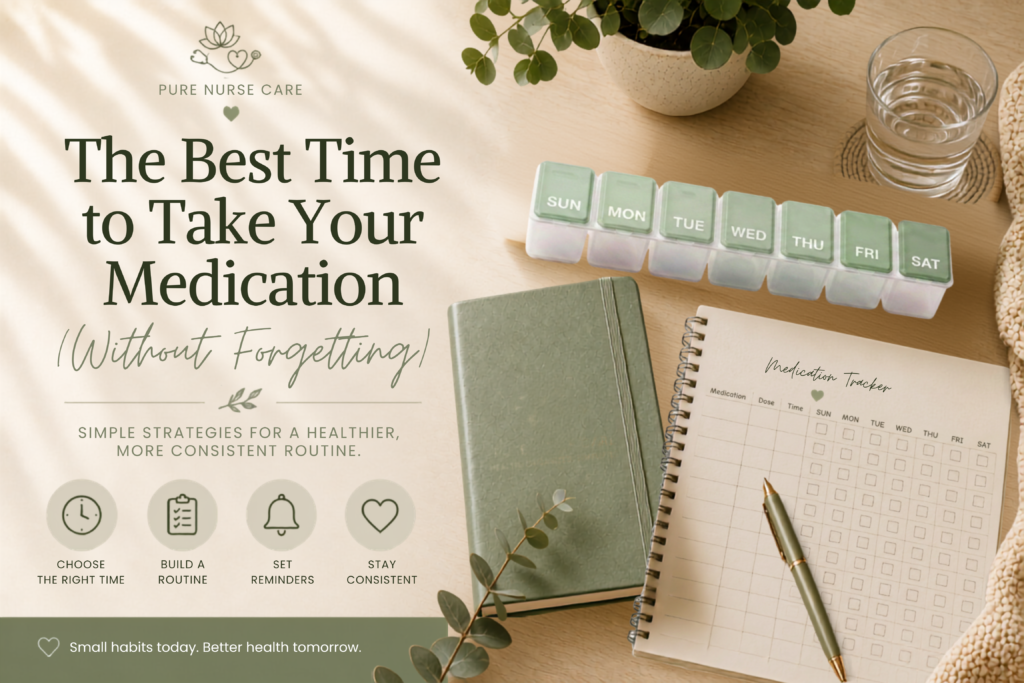
Taking medication sounds simple: take the right pill at the right time.
But in everyday life, it’s surprisingly easy to forget.
Busy mornings, changing schedules, work, appointments, family responsibilities — they can all interrupt your routine. And if you take more than one medication, keeping track can become even more difficult.
So, when is the best time to take your medication?
The answer is simple: the best time depends on the medication — but when timing is flexible, choosing a moment that naturally fits into your daily routine can make it much easier to remember.
Medication instructions can differ significantly. Some medicines should be taken with food, others on an empty stomach, and certain medicines need to be taken at specific times. Always follow the instructions provided with your medication or by your doctor or pharmacist.
Once you know when your medication may safely be taken, you can build a routine around it.
Why Medication Timing Matters
Taking medication as prescribed is an important part of getting the intended benefit from your treatment. Medication adherence refers to how closely someone follows the recommended way of taking their medicine.
But forgetting doesn’t necessarily mean you don’t care about your health.
Sometimes the problem is simply that taking medication isn’t connected to anything memorable in your day.
Instead of relying on memory alone, create a routine that does some of the remembering for you.
1. Connect Your Medication to Something You Already Do
Think about the things you do almost automatically every day.
For example:
Morning
- brushing your teeth
- making coffee or tea
- eating breakfast
- getting dressed
Evening
- eating dinner
- starting your evening skincare routine
- brushing your teeth
- preparing for bed
If your medication instructions allow it, connecting your dose to an established daily habit can create a useful mental cue.
For example:
Brush teeth → take medication → make coffee.
Over time, these actions can become part of the same routine.
This approach is also recommended in professional medication-adherence guidance: reminders can include linking medicines to meals or other regular daily activities.
Pure Nurse Care Tip: Don’t build an entirely new routine around your medication if you don’t need to. Attach it to a routine you already have.
2. Morning or Evening: Which Is Better?
There isn’t one universal answer.
For some medications, timing is important. A healthcare professional may specifically instruct you to take your medication in the morning, evening, before food, after food or at particular intervals.
For others, there may be more flexibility.
That’s why the first question shouldn’t be:
“What time is easiest for me?”
It should be:
“Does this medication need to be taken at a specific time?”
Check your medication instructions or ask your pharmacist, doctor or nurse.
If the timing is flexible, then choose a consistent time that fits naturally into your life.
3. Make Your Medication Visible — But Keep Safety in Mind
Visual cues can be powerful.
If you never see your medication, you’re more likely to go through your routine without thinking about it.
Professional guidance suggests that visible cues may help some people remember medication.
However, medication should always be stored safely, especially when children or pets are present. The FDA recommends keeping medicines where children cannot see or reach them.
Instead of leaving medication somewhere unsafe, you could use a visual reminder such as:
Medication → reminder card → planner → phone notification
The reminder can stay visible even when the medication itself needs to be stored securely.
4. Use a Medication Organizer
If you regularly find yourself wondering:
“Wait… did I already take it?”
a medication organization system may help.
Depending on your medication and the storage requirements, this could include a medication tracker, written schedule or — where appropriate — a pill organizer.
A written medication schedule can also help you keep track of exactly when and how your medicines should be taken.
Important: not every medication is suitable for removing from its original packaging. If you’re unsure whether your medication can safely be placed in an organizer, ask your pharmacist.
👉 Medication organization essentials
5. Set a Reminder on Your Phone
Sometimes the simplest solution works best.
Set a daily alarm and give it a clear name:
💊 Medication
rather than simply:
Alarm — 8:00 PM
That way, you immediately know why your phone is reminding you.
Phone alarms, planners and medication schedules are commonly suggested tools for helping people remember their medication.
And here’s an important trick:
Don’t automatically dismiss the reminder.
If possible, leave it active until you’ve actually taken your medication.
6. Keep a Simple Medication List
If you take several medications, supplements or vitamins, keeping everything in your head can become confusing.
Create one simple overview containing:
- medication name
- strength
- dose
- when you take it
- how you take it
- what you take it for
- important instructions
Keeping an up-to-date medication list can also help healthcare professionals understand what you’re taking and reduce the risk of medication errors or interactions.
👉 Download my Medication Tracker
7. What If You Forget a Dose?
This is where I would not give one universal instruction in your blog.
What to do after a missed dose depends on the medication, dose and schedule. Taking doses too close together can sometimes increase the risk of side effects, and some medicines have specific missed-dose instructions.
Instead:
Check the patient information leaflet or contact your pharmacist, doctor or nurse if you’re unsure what to do.
Never assume that doubling the next dose is the correct solution.
Create a Routine That Works for You
You don’t need a complicated medication system.
In many cases, consistency comes from making medication part of a routine that already exists.
Start small:
Choose your cue.
Set your reminder.
Keep track of your medication.
Repeat.
The goal isn’t to create a perfect routine.
It’s to create one that’s simple enough to actually use.
Ready to Make Your Medication Routine Easier?
Explore the Pure Nurse Care Medication Tracker to keep your medication schedule organized in one simple place.
👉VIEW THE MEDICATION TRACKER
Or discover my recommended medication organization essentials:
👉 SHOP MY RECOMMENDED MEDICATION ESSENTIALS
Some links on this page may be affiliate links. This means I may earn a small commission if you purchase through them, at no additional cost to you.
1. Weekly Pill Organizer
A weekly pill organizer can make it easier to organize your daily medication and see whether you’ve already taken a scheduled dose.
Important: Not all medication is suitable for storage outside its original packaging. Always check the storage instructions and ask your pharmacist if you’re unsure.
2. Travel Medication Organizer
A compact medication organizer can be useful for work, day trips or travelling, helping you keep your medication organized while you’re away from home.
👉 SHOP TRAVEL MEDICATION ORGANIZERS
Always check whether your medication can safely be removed from its original packaging and whether it has specific storage requirements.
3. Medication Storage Box
A dedicated storage box gives your medication and related supplies one organized place at home. Choose an option that allows you to keep medicines in their original packaging when necessary.
👉 SHOP MEDICATION STORAGE BOXES
Keep all medication safely stored and out of sight and reach of children and pets.
4. Pure Nurse Care Medication Tracker
Prefer having a clear overview of your medication routine? The Pure Nurse Care Medication Tracker helps you keep your medication schedule organized in one simple place — without changing how your medication itself is stored.
👉 VIEW THE PURE NURSE CARE MEDICATION TRACKER
This tracker is an organizational tool and does not replace medication instructions or professional medical advice.
Affiliate disclosure: Some links on this page may be affiliate links. This means I may earn a small commission if you purchase through them, at no additional cost to you.
Medical disclaimer: This article provides general educational information and does not replace individual medical advice. Medication timing, food requirements, missed-dose instructions and storage requirements vary between medicines. Always follow the instructions provided with your medication and consult your doctor, pharmacist or other qualified healthcare professional if you are unsure.
Ontdek meer van PURE NURSE CARE
Abonneer je om de nieuwste berichten naar je e-mail te laten verzenden.